

The Educational Value of Folk Tales
The Educational Value of Folk Tales - New Acropolis Library
Article By Pinar Akhan
posted by UK, April 30, 2022
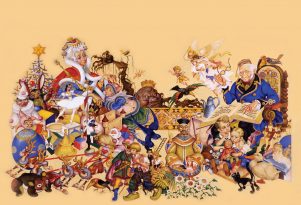 It is now a well-known fact that reading or telling stories to children starting from a young age has many developmental benefits. Just to name a few: stories can help to improve language and communication skills, develop the child’s brain with the ability to focus, help with associating and expressing their feelings, learning about the world, about nature, stimulate curiosity and imagination. Story-telling has been part of many traditions, folk stories passed down from generation to generation. In our modern times, however, it is not very common to grow up with folk tales.
Parents and teachers will often discuss the question of “what kind of stories should we tell, what kind of books shall we read to our children?” This has been a long-standing debate in education. In an attempt to find the best for our children, sometimes traditional folk stories are edited, some parts are removed or some aspects of the story are softened. Of course we have to be conscientious in whatever we teach or tell a young child, but we should perhaps also pay attention to the benefits of folk stories which traditionally were part of educating the next generation.
The demand for stories is an expression of the child’s desire to learn more about the wonders of the world around them, to get to the heart of things, to come into contact with the universe. Especially at the early ages of childhood, stories lay the foundation of character and intuitive understanding. Children who grow up with folk tales and learn to listen to them with open ears and hearts are likely to be able to formulate their own imaginative and creative response to challenging situations that they may face when they reach adulthood.
Einstein referred to fairy tales as one of the sources of his intelligence. He said “If you want your children to be intelligent, read them fairy tales. If you want them to be more intelligent, read them more fairy tales. When I examine myself and my methods of thought, I come to the conclusion that the gift of fantasy has meant more to me than any talent for abstract, positive thinking.”
Fairy tales have many symbolic elements. The prince, the tailor, the miller, Snow White… all of these are images of different elements in our own nature. It is this recognition and resonance that makes the characters feel close and familiar. The first steps of connecting with oneself and the world can be experienced through the deep feelings experienced through a story. These feelings can mature and bear fruit many years later in life.
Another aspect of fairy tales is that the hero or heroine must undergo certain trials or go on a journey before succeeding in his or her quest. There is an acceptance that it is necessary to prove oneself worthy of the reward at the end of the path, whether the reward is the hand of the princess or a kingdom. They confront evil and overcome it. The inner qualities of the hero or heroine, acceptance of the challenges of life, proving oneself, trusting oneself are only a few points that a child might experience unconsciously. This experience of strength will guide them to deal with the challenges of life later on.
In fairy tales there is also hope and trust. We see how the weak can become strong, the evil can be turned to good, each human being can rise to his or her true potential. This understanding and trust in life and in oneself may be the most important educational value of fairy tales.
Rudolf Steiner described the need for fairy tales beautifully: “Just as our body has to have nutritive substances circulating through the organism, the soul needs fairy tale substance flowing through its spiritual veins.”
Image Credits: By Arthur Szyk | Wikimedia Commons | CC BY-SA 4.0
The entity posting this article assumes the responsibility that images used in this article have the requisite permissions
Image References
By Arthur Szyk | Wikimedia Commons | CC BY-SA 4.0
Permissions required for the publishing of this article have been obtained
- Gnosis
- Mythos
- Rituals
- Wisdom
- Alchemy
- Prophecy
- Mystery
- Origins
- Divinity
- Awakening
- Cosmos
- Sacraments
- Light
- Truth
- Spirit
- Emanations
- Temple
- Legends
- Chronicles
- Revelations
- Creation
- Symbols
- Chakras
- Dreams
- Elements
- Guardians
- Mirrors
- Healing
- Frequencies
- Portals
- Codes
- Cycles
- Visions
- Temples
- Echoes
- Lightworkers
- Veil
- Ascension
- Runes
- Guardianship
