


Meet the Portrait Mummy of Herakleides
An online exhibition explores the identity of a 2000-year-old mummified man
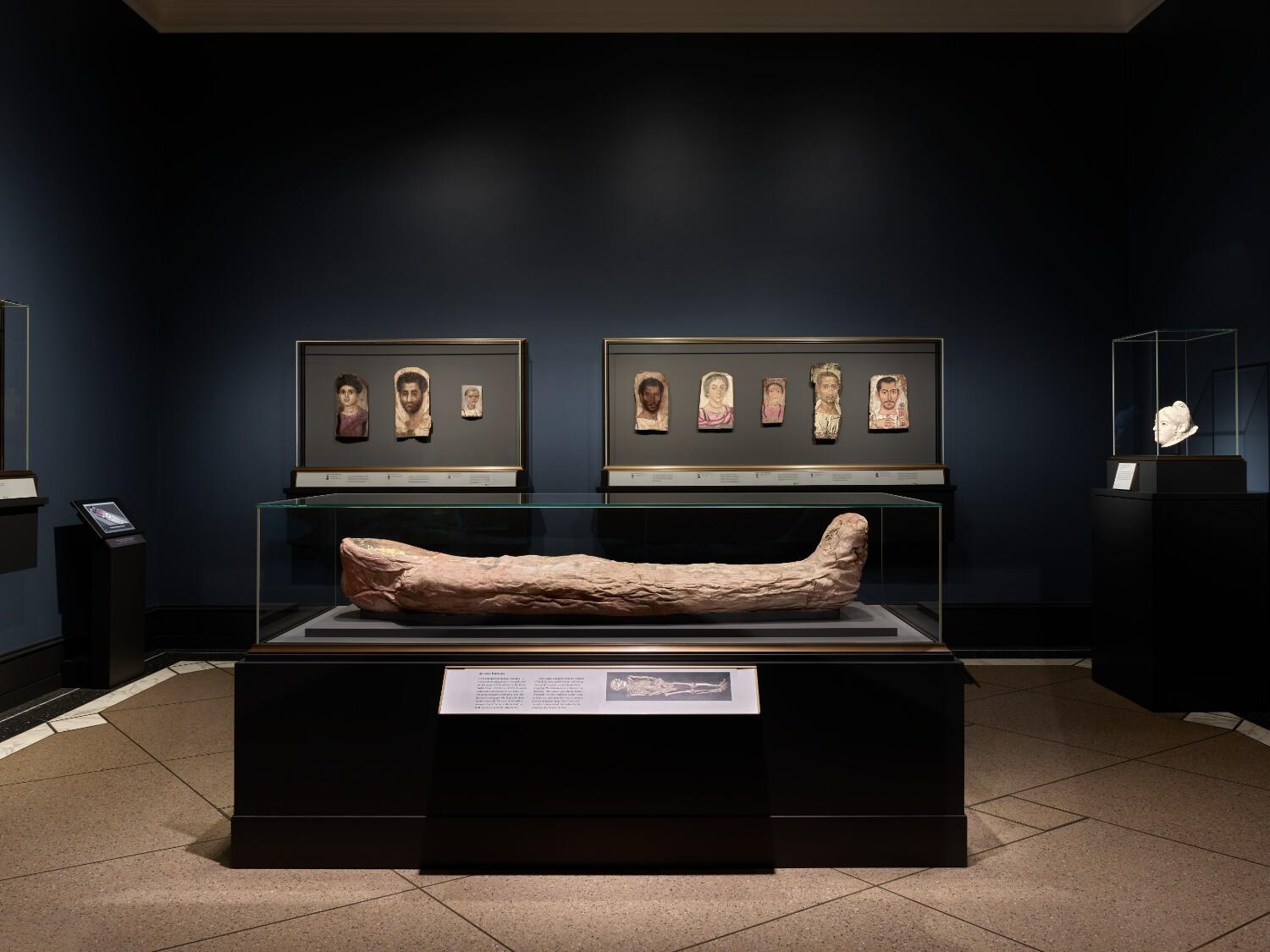
A faded inscription in black paint above his feet identifies this mummified young man as “Herakleides, son of Thermos.”
This detail is just one of many that provide clues about his identity and the time period in which he lived. Herakleides was an inhabitant of ancient Egypt when it was a province of the Roman Empire. He may have died around AD 120–140. Prior to this period, Egypt had been under the rule of a Greco-Macedonian dynasty (the Ptolemaic Dynasty) for nearly 300 years.
His Greco-Roman style portrait was incorporated into a mummification burial in the traditional Egyptian manner. Like so many of the individuals of mixed Greco-Egyptian heritage living in Egypt at this time, his identity and self-presentation included aspects of Egyptian, Greek, and Roman culture.
Herakleides’ mummified body has survived along with his painted portrait for nearly 2,000 years, providing a rare opportunity to examine a fully intact portrait mummy. Most Romano-Egyptian mummy portraits were separated from their mummies when they were found, leaving us with only the painted panels.
A recent study of his remains and the methods and materials used to create his portrait and burial shroud revealed more about elite burials in Roman Egypt, and highlighted the value of comparative studies where investigating the relationships among a group of artifacts can improve our understanding of ancient materials, their import, production, and use.
An examination of his bones and teeth indicated that Herakleides was around 18–20 years old when he died. The high quality of his painted panel portrait, achieved through the sophisticated rendering of his features, the skillful use of tempera on a thin linden wood panel imported from present-day Europe, and the application of gilding (gold leaf), suggest that he was a man of high social status. This is also reflected in the pigments and gilding used on his linen funerary shroud.
The analysis of the red pigment used to paint Herakleides’ shroud led to a groundbreaking discovery. The pigment was identified as a synthesized red-lead imported from Southern Spain, and its unique composition enabled it to be matched with other red-shroud Romano-Egyptian portrait mummies. Herakleides, and the other individuals who used red-lead on their shrouds, had the means to access the wide-ranging trade networks of the Roman Empire.
This finding identified a unique group of individuals who were all mummified, wrapped in shrouds painted with the same pigment, and decorated similarly.
The front of Herakleides’ shroud is decorated with painted and gilded images of Egyptian deities and other funerary symbols. These include an ibis—the sacred Egyptian bird representing Thoth, god of wisdom and learning—painted above his abdomen. A mummified ibis was also wrapped and placed over Herakleides’ abdomen beneath his shroud, corresponding with the location of the ibis painted on the outside.
While mummified animals were common in ancient Egypt, it was unusual to incorporate an animal with human remains. Herakleides may have had a personal connection to the god Thoth, perhaps as a priest or scribe.
Explore Herakleides’ burial and how it reflects the diverse cultural influences and extensive international trade connections in Egypt under the Roman Empire through its iconography, materials, and techniques in the new online exhibition: Investigating Herakleides: A Portrait Mummy from Roman Egypt.
- Gnosis
- Mythos
- Rituals
- Wisdom
- Alchemy
- Prophecy
- Mystery
- Origins
- Divinity
- Awakening
- Cosmos
- Sacraments
- Light
- Truth
- Spirit
- Emanations
- Temple
- Legends
- Chronicles
- Revelations
- Creation
- Symbols
- Chakras
- Dreams
- Elements
- Guardians
- Mirrors
- Healing
- Frequencies
- Portals
- Codes
- Cycles
- Visions
- Temples
- Echoes
- Lightworkers
- Veil
- Ascension
- Runes
- Guardianship
